Benevolence
Synopsis
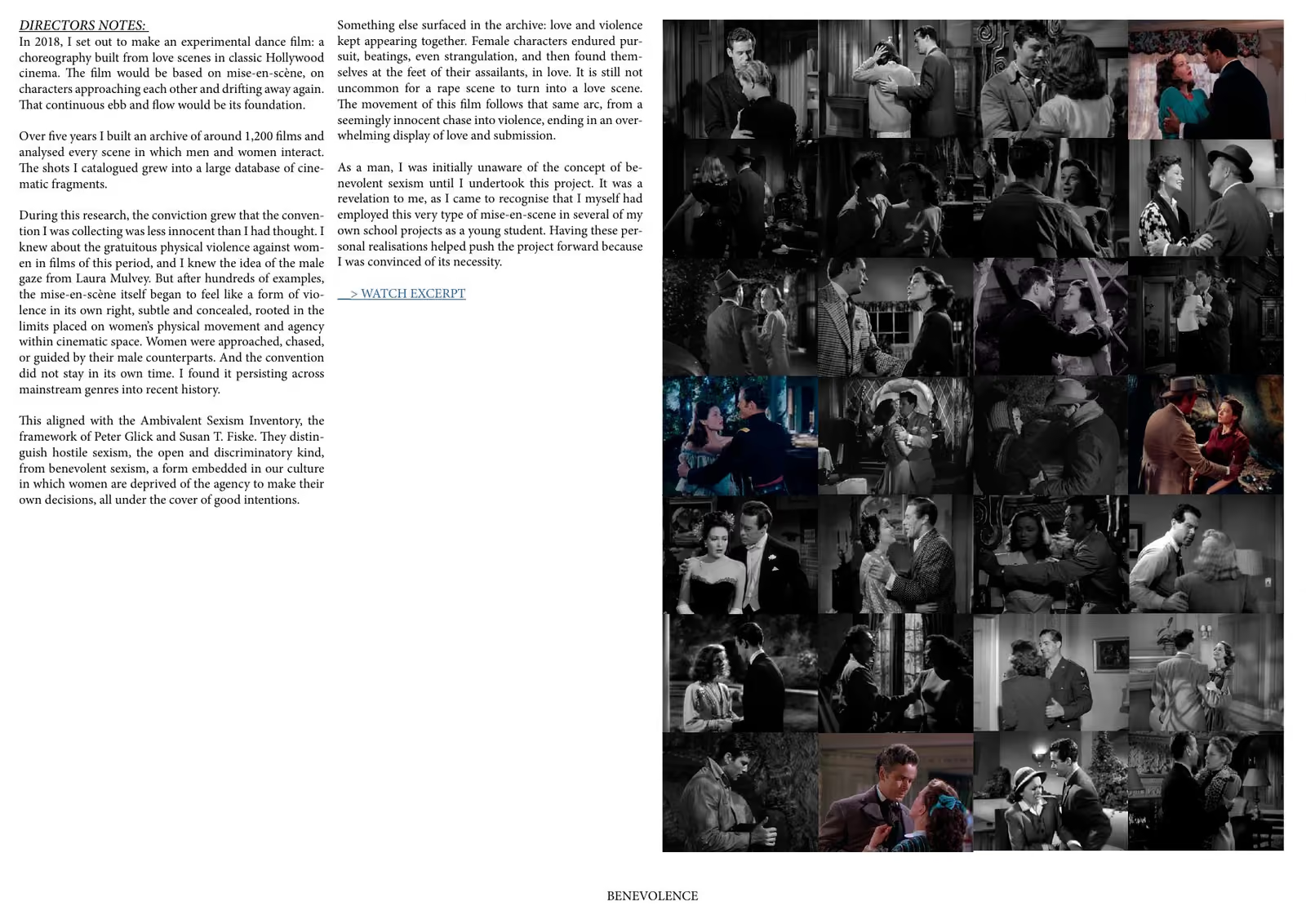
Benevolence is a flicker film assembled entirely from immediate post-war Hollywood cinema, 1945 to 1949. Over five years, every scene in which men and women interact was catalogued across roughly 1,200 films. These scenes were cut into segments of seven frames and interwoven into one continuous choreography, an ebb and flow of bodies approaching and withdrawing.
At that speed the individual film disappears and the convention becomes visible. Women are approached, guided, chased and hemmed in, their movement and agency restricted under the cover of good intentions. Glick and Fiske call this benevolent sexism. In these films it lives in the staging rather than the story. The movement of the film follows the same arc as the scenes it is made of: a seemingly innocent chase develops into violence and culminates in an overwhelming display of love and submission. The film not only questions the normative framework of that time but also challenges the cinematic conventions of today, as many of them are still in use.
“It’s disconcerting, disorienting, and ultimately really powerful … The worry and fear in the women and the menace in the men becomes very palpable. … The video speaks for itself at a visceral level, but yes it fits with an ambivalent sexism analysis and shows very clearly how all of this has been fused with cultural images, scripts and norms about ‘romance’.”
“Stereotypes of movement and gaze, of dominance and subordination, take on an almost monstrous dimension here.”
Technical
- Year
- 2024
- Country
- Belgium
- Duration
- 13'48"
- Format
- HD video, 4:3, colour
- Language
- No dialogue, language independent
- Presentation
- Single channel screening and installation
- Status
- Available for screening and exhibition
Contains intense flicker effects.
Screenings & exhibitions
- 2026Miroir Miroir, Biennale de l'Image Possible (BIP2026), Liège, Belgium (17 October – 13 December 2026)
- 2026Screening: Costumes, Das Leben am Haverkamp, The Hague, The Netherlands (November–December 2026)
- 2026Galerie Fotografic, Prague, Czech Republic (solo exhibition, until 12 September 2026)
- 2026Sleepy Eyes, The Hague, The Netherlands
- 2025Bangkok Experimental Film Festival, Bangkok, Thailand
- 2024Rencontres Internationales, Paris, France (23 November 2024, programme "Gender approach", Cinéma Pathé Les Fauvettes)
- 2024Centrale for contemporary art, Brussels, Belgium
Director's notes
In 2018, I set out to make an experimental dance film: a choreography built from love scenes in classic Hollywood cinema. The film would be based on mise-en-scène, on characters approaching each other and drifting away again. That continuous ebb and flow would be its foundation.
Over five years I built an archive of around 1,200 films and analysed every scene in which men and women interact. The shots I catalogued grew into a large database of cinematic fragments.
During this research, the conviction grew that the convention I was collecting was less innocent than I had thought. I knew about the gratuitous physical violence against women in films of this period, and I knew the idea of the male gaze from Laura Mulvey. But after hundreds of examples, the mise-en-scène itself began to feel like a form of violence in its own right, subtle and concealed, rooted in the limits placed on women's physical movement and agency within cinematic space. Women were approached, chased, or guided by their male counterparts. And the convention did not stay in its own time. I found it persisting across mainstream genres into recent history.
This aligned with the Ambivalent Sexism Inventory, the framework of Peter Glick and Susan T. Fiske. They distinguish hostile sexism, the open and discriminatory kind, from benevolent sexism, a form embedded in our culture in which women are deprived of the agency to make their own decisions, all under the cover of good intentions.
Something else surfaced in the archive: love and violence kept appearing together. Female characters endured pursuit, beatings, even strangulation, and then found themselves at the feet of their assailants, in love. It is still not uncommon for a rape scene to turn into a love scene. The movement of this film follows that same arc, from a seemingly innocent chase into violence, ending in an overwhelming display of love and submission.
As a man, I was initially unaware of the concept of benevolent sexism until I undertook this project. It was a revelation to me, as I came to recognise that I myself had employed this very type of mise-en-scène in several of my own school projects as a young student. Having these personal realisations helped push the project forward because I was convinced of its necessity.
Installation views


Presentation
Single-channel HD video, 4:3, 24 fps, silent, 13'48". Master in ProRes; the film should be played from a native 24p source.
My preference is for the work to be shown in a modern context, such as an LED wall or a large projection rather than a monitor, to break away from the nostalgia of the films it is made of. It can run as a loop in an exhibition or as a single screening.
The film is a seven-frame flicker film. A photosensitivity notice at the entrance of the space is required.
Screening files, stills and the press kit are available on request.